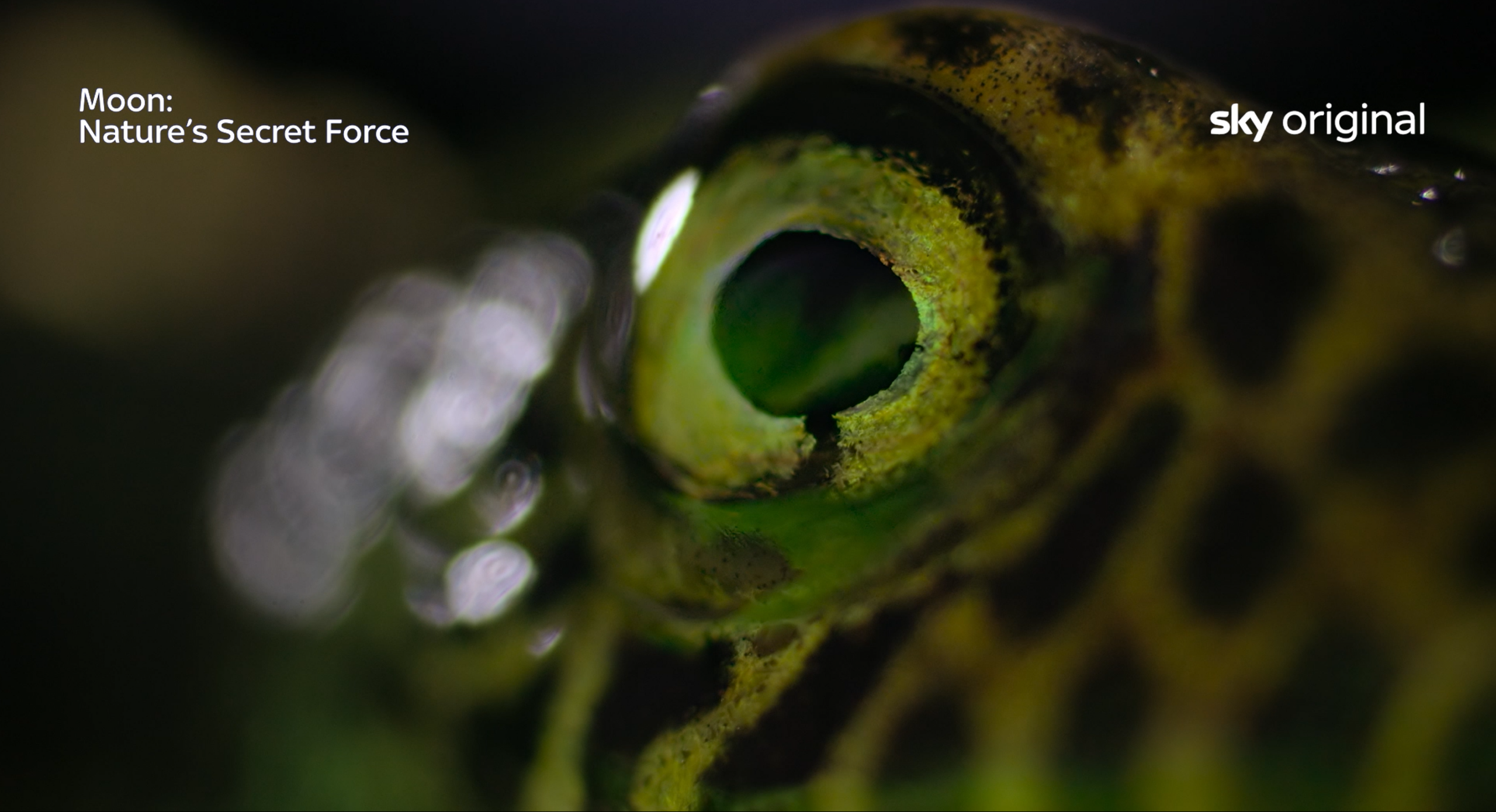
BAFTA- and EMMY-winning natural history specialists Humble Bee Films collaborated with MyWorld to create a sequence for a new Sky Nature and Blue Ant Media series exploring the Moon’s influence on animal behaviour. The team set out to capture something never-before filmed: the role of Earth’s electromagnetic field on a finger-sized Alpine newt navigating from deep forest to its breeding pond.
In a bold approach, they used virtual production to attempt a world-first in natural history filmmaking, aiming to create something both visually stunning and scientifically grounded.
“For delicate species like newts, controlled studio environments are essential—not just for animal welfare, but for precision storytelling. Indoors, light, weather and motion become cinematic tools. The challenge is ensuring the world feels authentic to the animal and the audience.”
Robert Wilcox, Producer-Director, Humble Bee Films
Challenge
The sequence needed to visualise natural phenomena that humans cannot see, while depicting a nocturnal woodland environment without disturbing wildlife by filming on location under moonlight. Traditional studio techniques such as blue screen, translights and looping video often lack realism, limit camera movement and creative flexibility, and increase post-production time and costs. The team needed a way to create an authentic natural environment while maintaining complete control over lighting, weather and filming conditions.
Approach
The production used an LED volume for virtual production. Physical moss, logs and stones were integrated into the set, seamlessly blending real and virtual elements, and creating a believable world for the newt to explore. This allowed the filmmakers to create a believable woodland environment that could be lit, animated and filmed entirely in-camera. They could instantly change the time of day, simulate changing weather conditions or adjust the landscape without rebuilding sets or waiting for the right conditions.
Result
Virtual production offered far greater creative control while delivering significant production efficiencies. The team could review and refine shots on set, enabling faster decision-making and reducing the need for extensive post-production. Compared with a conventional studio production, the newt sequence was completed in around one-third of the time, saving approximately five filming days. Shooting locally also resulted in an estimated 70% reduction in travel-related costs and environmental impact compared with filming in a European forest location.
“We could manipulate time and space at will: shifting light from dawn to dusk, changing the weather, or even moving individual trees with a click of a mouse.”
Robert Wilcox, Producer-Director, Humble Bee Films
This project demonstrated how virtual production can overcome many of the limitations of traditional natural history filmmaking. By combining real-world scanned environments with LED volume technology, Humble Bee Films created a scientifically grounded, visually immersive sequence while improving production efficiency, reducing costs and minimising environmental impact.
The virtual environment also enabled more dynamic camera movements, cinematic lighting and greater visual depth, creating a convincing portrayal of the newt’s natural habitat without introducing the disruption of a real film crew.
“Production companies working on ever tighter budgets often don’t have a chance to experiment, so working alongside university researchers, using cutting-edge technologies and facilities, such as these, allows industry to push those envelopes”
Mitch Turnbull, Senior Research Associate in Immersive Productions, University of Bristol